
Where we work
10 counties across North Texas.
Every ZIP in our hardness lookup falls inside these ten counties — a full ring around Dallas and Fort Worth. Here's everywhere we serve, and what actually makes each area's water different.
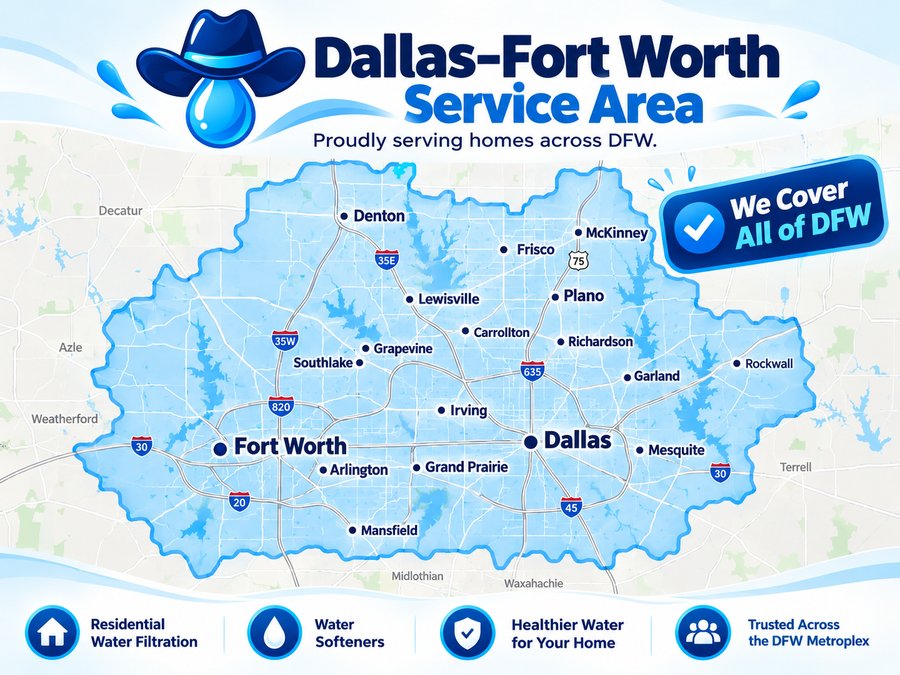
Every ZIP in our hardness lookup falls inside these ten counties — a full ring around Dallas and Fort Worth. Here's everywhere we serve, and what actually makes each area's water different.
The urban core of the metroplex — Dallas Water Utilities supplies most of it, along with several surrounding cities that buy treated water from the same system. Water runs hard county-wide, and older neighborhoods with original plumbing tend to show scale damage faster than newer construction. See the Dallas page →
Fort Worth Water supplies most of the county, with a Trinity River Authority blend across several Mid-Cities suburbs. Arlington runs its own separate system, drawing from four reservoirs including Lake Arlington itself — and reads even harder than Fort Worth. This is one of the more consistently hard-water counties in our service area — scale on fixtures is the norm here, not the exception. See the Fort Worth page → · See the Arlington page →
Plano, Frisco, Allen, McKinney and the rest of Collin County draw from the North Texas Municipal Water District. Lots of newer construction here, which surprises people — a five-year-old house scales up just as fast as an older one if the water coming in is hard.
A mix of the City of Denton's own system and the Upper Trinity Regional Water District across the rest of the county. Denton is also where we see the most private wells in our service area alongside city water, so the right system depends genuinely on which one you're on.
South of Dallas — Waxahachie, Ennis, Red Oak and the surrounding area. A genuine mix of treated municipal supply in town and private wells once you're out past the city limits, which changes what system actually makes sense.
East of Dallas — Kaufman, Terrell, Forney and the fast-growing Heartland area. Newer subdivisions on municipal supply, with older properties further out still commonly on private wells.
The smallest county in Texas by area, and one of the fastest-growing. Almost everything here runs on North Texas Municipal Water District supply, and the housing stock is new enough that owners are often surprised how quickly scale shows up anyway.
South of Fort Worth — Cleburne, Burleson, Joshua and Godley. Well water is common outside the town centers, and this is where we see more iron and sulfur treatment needs than anywhere else in our service area.
West of Fort Worth — Weatherford, Aledo, Willow Park and Springtown. Genuine well-water territory: big lots, private wells, and hardness readings that regularly come back higher than anything on the city side of the county line.
Northwest of Fort Worth — Decatur, Bridgeport, Rhome and Newark. Predominantly rural, predominantly well water, and the part of our service area where a hardness reading most often changes what we'd actually recommend.
If you're just outside one of these counties, call — we likely still cover it. Or check your exact ZIP's real hardness reading right now.